
Post
Automating and Improving Customer Discussions with AI
How I simplified and automated my client prep discussions with AI
April 27, 2026
I Built a Tool That Does My Pre-Call Homework For Me
Going from a corporate data leader to a consultant means learning a completely different motion. Internal stakeholder alignment is a skill. Selling your value to someone who has never met you is a different skill entirely. I'm still learning it.
One thing I can control is how prepared I am before a first conversation. That starts with research.
What I Actually Need to Know Before a Discovery Call
When a potential client fills out my intake form, I get the basics. Company name, what they're dealing with, how they found me. That's enough to know whether there's a fit worth exploring. It's not enough to walk into a call with confidence.
What I actually want to know depends on who I'm talking to.
For larger operators, I'm thinking about governance, tool sprawl, who actually owns the data function, and whether there's a catalyst behind the outreach. A leadership change, a board mandate, a bad audit. Something prompted this.
For smaller companies, I want to know if they're still living in spreadsheets, whether an external vendor is driving their data development, and how that relationship is going. Vendor dependency is one of the most common pain points I run into.
The tech stack tells its own story. New tooling means recent investment. Recent investment means someone made a bet, and they need it to pay off. Hiring data engineers and analysts without a strong foundation is exactly the kind of situation I can help with.
Financials matter too. Are they in cost-cutting mode or growth mode? That shapes everything about how I frame the conversation.
And M&A activity? That's a special category. Nothing creates data chaos faster than an acquisition. New systems, duplicate records, conflicting definitions, political battles over whose version of the truth wins. That's a busy season for people like me.
The problem is that pulling all of this together manually takes time I don't always have before a call.
Enter Claude Artifacts
I worked through how I actually do this research, mapped out what questions I'm trying to answer, and then built a repeatable artifact that does it for me.
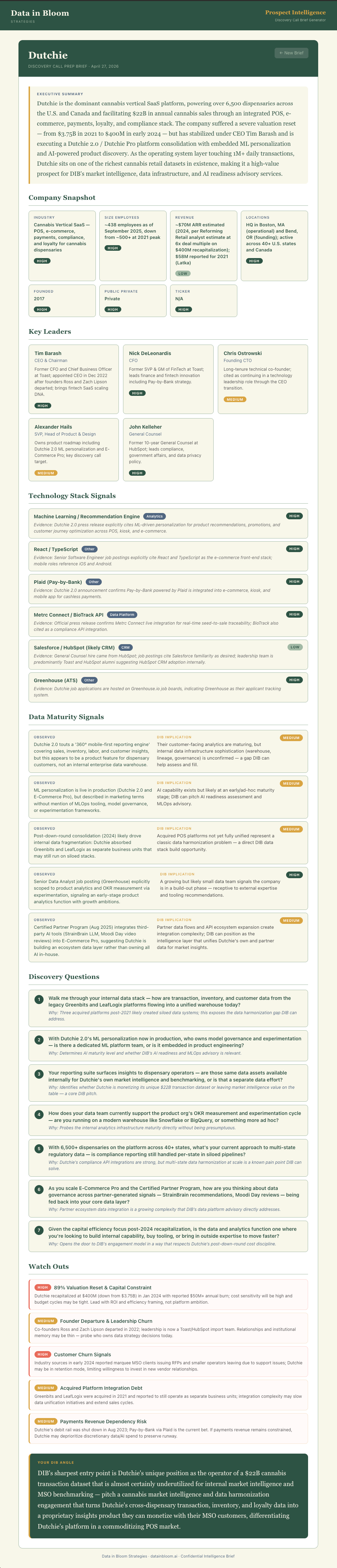
The brief pulls live web search, scans the company's website, checks job postings for tech signals, and outputs a structured report. Company snapshot, key leaders, inferred tech stack, data maturity signals, tailored discovery questions, and watch-outs. Every insight gets a confidence level: High, Medium, or Low, based on source quality. High means it came from an SEC filing or an official bio. Low means it came from a single weak signal and I should verify before leaning on it.
I also pushed it to do things I genuinely wouldn't take the time to do myself. Examining their digital assets. Inferring stack details from job postings and product pages. That kind of passive signal reading takes forever manually. The artifact does it in seconds.
Once I was happy with the outputs, I wrapped it into a shareable mini-app. If you have a Claude subscription, you can actually run it yourself at the bottom of this post.
How It Fits Into the Intake Flow
The process is simple.
Someone fills out the contact form on this site. That data lands in my Google Workspace, which kicks off the brief generation automatically and saves the output for my review before the call.
Intake Form → Google Sheet → Brief Generation → Discovery Call
By the time I'm on that first call, I already know what I'm walking into. I can ask sharper questions, reference the right pain points, and give the person on the other side confidence that I've done my homework. That trust matters early. It's hard to recover from a first impression of being underprepared.
Here's what the output looks like for Dutchie, the cannabis POS and e-commerce platform:
Why This Matters Beyond My Use Case
This is how I prep for sales conversations. But if you have any kind of B2B sales motion, you can lift and shift this for your field team with minimal work. Sharper reps, better first calls, more deals closed.
And even if outbound sales isn't your thing, you almost certainly have manual internal processes that would benefit from this kind of intelligence layer baked in. Research that used to take an hour shouldn't take an hour. More time executing, better decisions, and something that actually scales.
If you want to shape something like this for your team, fill out the intake form and let's talk.
Try the interactive brief
Claude Artifacts currently blocks third-party iframe embeds, so the live tool opens in a new tab.
Open Prospect Intelligence Brief